For the Love of Books #27

Stopping by to share a love of books, and this time a look at fantastical creatures. There are so many great titles to choose from, but I’ve gone for three, each with a unique flavour…
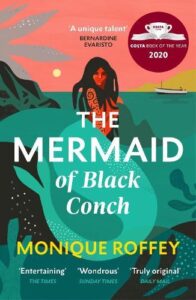
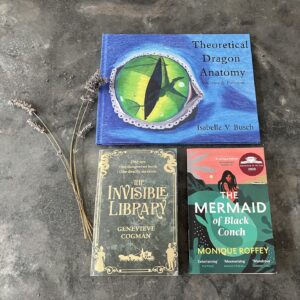
The Mermaid of Black Conch; by Monique Roffey

In the Black Conch waters, one mile off Murder Bay, David Baptiste meets Aycayia:

“…long, long ago I don’t know the time, only that they called up a huracan, to take me far away, seal up my legs inside a tail.’

And from that day, whenever the leatherbacks arrive, he knows she will soon appear. No woman can compare to his mermaid, leaving a heart of sorrow to drown in a bottle of rum, while he finds the words to write the story down. She was an interruption in the middle of God’s act of creation, cursed by women to seal her sex inside a big tail, to keep her away from their men. And when the Americans caught her, David Baptiste is left feeling the sorrow of believing it was his fault.

Set on an imaginary Caribbean island, this is a wonderfully textured, layered read that pulls on all the senses. Tantalising in its entanglement of the mythical blended with visceral realism of everyday life. The place was brought to life, the love between man and mermaid felt as real a blackbird’s song, and the story arc weaving between past and present brought reflections of life’s loves, losses and desires into sharp focus. A lively, colourful, triumphant treat of a book. Needless to say, I adored it.
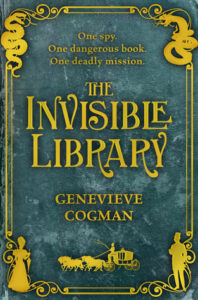
The Invisible Library; by Genevieve Cogman

The Invisible Library is a fun read, that overall has the feel of game playing within the realms of story-telling, with rules and payoffs to magic along the ride. The story stars Irene, a professional spy for the mysterious library, harvesting fiction from different realities. She is a character who is sure of herself, content and confident in her chosen profession, courageous in her various assignments to alternate worlds. The latest assignment is to an alternative London to retrieve a dangerous book, along with her assistant, Kai. But nothing is as it seems in chaotic alternate worlds.

I enjoyed the characterisation, and representation of an older woman unflinching in adventure, and courageous in the face of, well, anything. It was also a refreshing dynamic to see her play an older role model to the young man Kai. Fae creatures of chaos and magic await, an infestation of vampires, werewolves and technology working in weird ways, and Irene is soon on the run from gargoyles and hellhounds, only to stumble upon steampunk creatures to delight the imagination of any reader – creatures that also extend to the idea of the monster inside us. But what exactly is the sinister character laying in wait…?
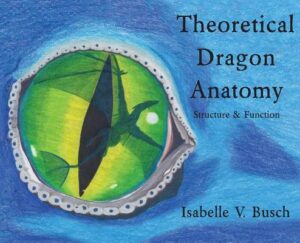
Theoretical Dragon Anatomy; by Isabelle V. Busch

Is it true that dragons wholly belong in the mythical beast category, are they truly fictional, or are they formed from fragmented fact? Theoretical Dragon Anatomy is a biology manual, innovative in ecological thinking, problem solving, theorising, and containing intriguing and beautiful artwork to further illustrate the hugely absorbing information. With scutes and sensory pores shared with swimming alligators, wing structure akin to their pterosaur ancestors, a cardiovascular system resembling that of a bird, not to mention a digestive system with crops akin to their avian friends, and embryology that draws lines to lizards, snakes, chickens, crocodiles and bats… I can honestly say that dragons have never felt so familiar, a fact I have thoroughly enjoyed discovering. Oh, and did someone mention a flamme gland… yes, all wrapped up with some dragon pyrotechnics…

What are you reading?
For the Love of Books #26

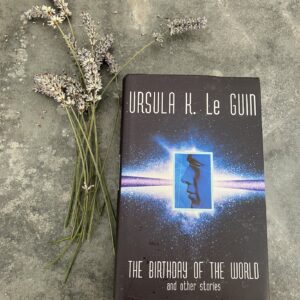
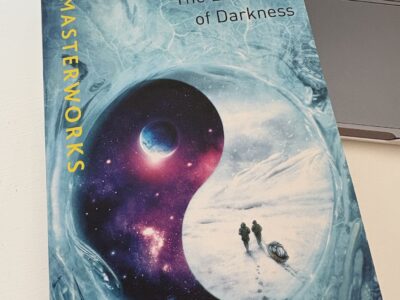
If ever I needed a reminder of the heights of great worldbuilding, this collection, from one of our great SFF pioneers, Ursula Le Guin, offers a masterclass. Eight short stories and novellas bring us worlds near and far, those travelling between worlds, and shifting perspectives from outwards to inwards with thought-provoking poignancy.

The Birthday of the World; by Ursula Le Guin

To give you a sneak peek into the inner workings…

The Birthday of the World

The Birthday of the World is considered to be the time the sun stands over Mount Kanaghadwa, when people count themselves a year older, although the rituals and ceremonies are no longer remembered. In a society struggling with their concept of god, the narrator reflects on their own beliefs, rituals and ceremonies, layering a world where gods dance and die, and wild dragons fly. But with wars at the borders, lands have grown too large and the existence of God itself is threatened. The world must die so that God may live, and so the narrator is left pondering the identity of God itself.

Old Music and the Slave Women

Esdan, a chief intelligence officer, ends up on a clandestine mission during a civil war. Intercepted by government forces, he is imprisoned on a large slave estate, where his perspective becomes increasingly limited. In a brutal world, this is a story of survival, and hopeful endeavour in the coming revolution. Will the rebellion reach them? From humiliating violence, to muddy waters of human inequity in supposed liberation, to the failings of world construct to deliver utopia, it is in the bonds between slaves that kindness and comfort is found, and where the heart of the story lies.

Paradise Lost

On a multi-generational voyage to a potentially habitable planet, Liu Hsing and Nova Luis are members of the fifth generation born on the space ship. Many are excited by the idea of discovery, a planet to explore and send information back to the human species. But some people, especially the older generation, subscribe to the religion of Bliss – the state of a blissful journey, with no end. For them, Bliss is the only reason to stay alive. Liu and Nova are faced with followers of the religious cult who question if living on a planet is such a joy. There are also environmental themes, highlighting the challenge of making change, and the overall question of what is natural and what is not. An interesting read, fascinating in its construct, and thought-provoking in the themes of isolation, religion and utopia.

Solitude

Solitude is told by the narrator, as she reflects on her experiences growing up on Eleven-Soro. Her mother was an Observer, whose work involved settling among the native people of Eleven Soro, to learn about this complex alien world. Cultural differences between mother and daughter eventually drive them apart. Where the mother shuns the alien culture, the narrator adopts it as her own, wanting to grow her soul and experience what it means to be  a person of that culture. It is a theme reflective of generational confusion, complicated by outside influence. It is also an interesting use of perspective, approaching the culture of Eleven-Soro from a colonised mindset, yet entirely shifting perspective onto a young woman who becomes part of it. Cultural norms are highlighted, which require societies of modest population, driven by a desire for solitude and the social norm being introverts, perhaps essentially selecting for autism. In true style of Ursula Le Guin, subverted expectations are delivered with ease, which illuminate and surprise, in this creative and thought-provoking world.

The Matter of Seggri

Set in the dystopian society of Seggri, the story is written as a first contact report on the ship’s log of the Wandership. The captain describes a complex society which demonstrates gender as a social construct. Gender expectation is subverted and replaced with inventive roles. The impact of colonialism is also questioned, with consideration given to a society destabilised by outside contact. Previous colonial interference messed with chromosomes, which now results in there being sixteen women for every one man. In the present day, men have all the privilege and women have all the power. Given the opportunity, would men cling to their privileged status or demand freedom, and would women resist giving up their power? Would the sexual system break down?

Unchosen Love

In a world textured with colour, legend and mystery, a polygamous society is structured around family units called sedoretu. Hadri has been chosen to join one such family, after a man seeks out his affections. Homosexual and heterosexual coupling is commonplace, and various aspects of relationships are explored, including the more insidious coercive control.

‘Being unhappy in a room is worse than being unhappy outdoors.’

It is following one mysterious encounter that Hadri comes to realise his true feelings. It is a startling discovery, not least for himself, and brings with it a tantalising coming-of-age feel.

Mountain Ways

This story continues with the themes from Unchosen Love, with society structured around the same sedoretu units. Two women fall in love outside of convention, but over time they conform and strive to form a sedoretu. Through it we see the cost of compromise, the bitterness of conformity and restriction, a stark contrast to two previously independent souls. It was an intriguing and illuminating play on character, that also undoubtedly left a bitter taste. There was also an interesting interplay with the natural world, challenging the concept of ownership. I particularly enjoyed the portrayal of environmental equity.

Coming of Age in Karhide

Set on the fictional planet of Gethen, a place where adults have no fixed gender identity, the story follows Sov Thade Tage em Ereb, a teenager living in a large communal home in the Karhidish city of Rer. As Sov experiences biological changes, it is clear they are ready for kemmer, held in a communal Kemmerhouse for those sexually receptive. Any children conceived in the Kemmerhouse are raised in the communal home, the hearth. Sov and their friend, both ready for kemmer, express fears that being in kemmer is dehumanizing, being seen as a sex machine. And so Sov’s coming of age story is told, of changing bodies and sexuality that was utterly relatable, as well as a meaningful alternative look into gender identity in a place where, quite simply, love is love.

What are you reading?

For the Love of Books #25

Summer is here, the lavender is in bloom, and it’s the perfect time to cast away into imaginative landscapes anew. While I fine tune the layers of my third instalment of Blood Gift Chronicles, checking depth of sweeping landscapes filled with magic and colour, I smile to think of the times my work has been compared to Ursula Le Guin’s. Huge compliment, and she is of course a wonderful source of inspiration. And I’m also honing in on the characters, seeing them in my mind’s eye, carving out strengths they never knew they had.

I adore character arcs that surprise, illuminate, fill with dread and show possibility, the storylines that find new paths, reflect, inspect and seek out the poetry of humanity. While I continue on the path for my own story, this train of thought brought a wonderful title to mind, with characters I simply adore. Enjoy…

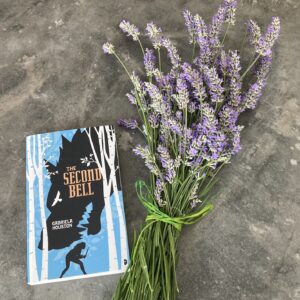
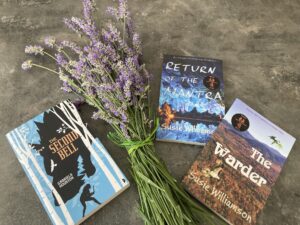
The Second Bell, by Gabriela Houston

The Second Bell is an intimate and heartfelt tale that had me captivated from the start. Set in an isolated mountainous community, we first meet Miriat, a woman faced with an impossible choice. She has a daughter named Salka, but Salka is no ordinary girl: she is a striga, a child born with two hearts, considered to be a dangerous demon. Salka’s fate is to be banished from the community and likely perish in the wilderness. But Miriat will not abandon her daughter and instead leaves with her, to face a life of hardship and deprivation. They reach a remote outcast village where previous strigas have gone before. It is a suspicious community with harsh self-imposed laws: it is forbidden for a striga to follow the impulses of their second heart; to do so faces the punishment of having their second heart burned out of their chest. For a mother like Miriat, the advice is simple: since an infant cannot be expected to have any self-control, ensure the other heart doesn’t have any reason to assert itself.

Miriat’s personal story arc is one I adored, demonstrating a mother’s unreserved and steadfast love for a daughter whose very existence is a fight for survival; a love uncompromising in its willingness to self-sacrifice. Immersive writing takes you deep into the heart of the community, where villagers share bonds of communal living and struggle, sacrifice and an uncompromising vision. An array of characters come to life on the page, with needs and desires, loyalties and betrayal, where seers are revered and the most indoctrinated hide secrets.

Fast forward years later and Salka is a young woman, still living with her mother in the village, and trying with all her might to adhere to the rules. She is taught self-loathing for a power that is integral to her, and to approach life with self-discipline that leaves no room for compassion. She is soon tested, and fails, and tested again, to the point she might break. And as the reader, I was rooting for her each step of the way, appalled and teased by a complicated community that enforce bleak truths and live out hypocrisies. Salka’s journey is one of courage and loyalty to integrity, compassion and truth, one that encourages the reader to reflect on what it means to be human, what it means to dare to embrace ourselves. A wonderful and unforgettable read.

What are you reading?

A Change of Nature

Following on from my last post, the theme of nature is still in mind. In the garden, the lavender is growing, the hedgehog is visiting, and stray newts are making random appearances in the grass, despite there being no pond…

With a backdrop of bird’s singing, and the gentle hush of nearby bamboo brushing in a summer breeze, it’s a textured backdrop. Add to this, trips to the beach for some sea air, edged by sienna cliffs of the Jurassic coast, home to nesting birds and basking seals, and more layers of fabric add to the scene.

Sights, sounds, colours, scents and the all-important feels, develop a tangible world. Worldbuilding has been the focus of my novel writing in recent months, that and the courage to attack a re-write with renewed vigour, and a capacity to allow for organic change. The changes were greater than I had first imagined, and the efforts are paying off. The key – layering the world, being true to the world, true to the characters, embodying perspectives and when those perspectives necessarily alter, breathing into the flow and, quite literally, taking flight. There’s a clue there somewhere, though dragons are no secret. Then comes the interesting question of perception, and as I’ve said before, I’m going with my own inventive model of dragon, with explanations rife in a world where magic is its own science.

Subverting expectation is a common theme in my work, often times associated with gender. it’s an interesting concept to combine this with dragons, considering the concept of power, the expectation of power, contrasted with the truth of identity. The answers are coming and I’m excited to see them revealed… after more rewrites. A story is written once, and it is worth taking the time.

For now, a breath of fresh air and some sun… Have a great weekend, everyone…


Nature’s Magic

Summer is upon us and the weather is warm warm warm. Still, no excuse for not sitting indoors writing! And the writing is flowing, for an array of shorts, and for the novel. Inspiration is a common theme, and I don’t have to look far to be inspired, by nature, by colour, by stories both personal and fictional.

A recent trip to the river Otter gave a glorious fix of wildlife, or at least a tantalising reminder of those special moments of hope. Following Devon Wildlife Trust’s successful reintroduction of beavers into the area, I had hoped that maybe, just maybe, I might see one. Alas, it was not meant to be, but special in any case to see gnawed trees and an impressive dam. Given a chance, these industrious creatures are fighting back against flooding, while bringing a whole host of species back into area – the magic of nature. And so we looked, scouring the riverbank, soaking up the wild atmosphere.


(Click here for more about the river Otter in a previous blogpost – #lovedevon)

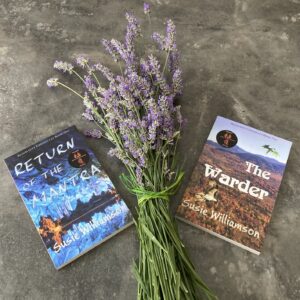
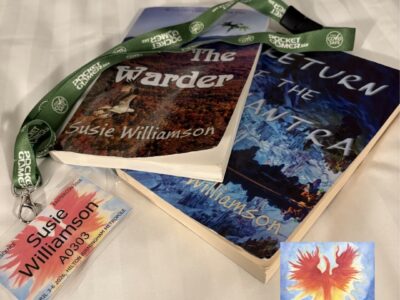
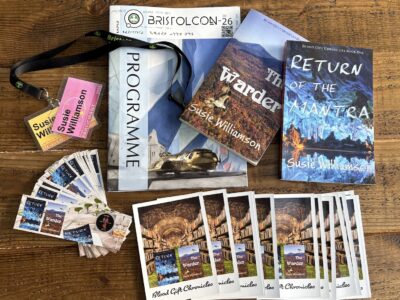
Nature is a prominent theme in my series, Blood Gift Chronicles. In Return of the Mantra, I explore the cost of exploitation; in The Warder, it’s the fight to preserve wildlife; and in Book 3, there’s a personal connection with the natural world, so personal we might actually merge. Like its predecessors, Book 3 is bringing a personal arc that is out of this world, transformational, and colourful.

Colour…

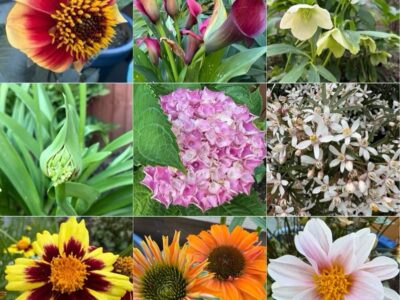
At home, flowers are starting to bloom…

The bikes are out…

There’s art in the cathedral on the theme of nature…

And my own art is slowly taking shape.

Colour, nature, magic…

What’s your inspiration?
For the Love of Books #24

With summer upon us, I thought I would bring you some wonderfully inventive reads, colourful enough to add vibrancy to any sun-filled day. It’s a trilogy of novellas, bringing us Binti, a young woman from the Himba people, who reveals Namibia in a whole new light, treating us to an intimate glance of the rich traditions of this tribe: a desert people who wash with red clay and oils from flowers. Or at least it starts that way…

From an author intent on showing the magic of Africa through the magic of Africanfuturism.

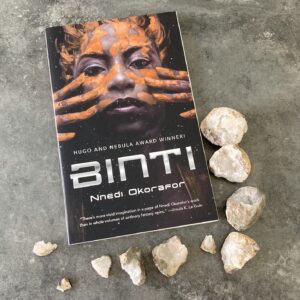
Binti, by Nnedi Okorafor

Binti is the first of Namibia’s Himba people to be offered a place at Oomza University. But to take the place means defying her core traditions, leaving her family behind, and risking scandilizing her entire bloodline. Nevertheless, she heads out into the galaxy and into a world that incorporates biotechnology, with space ships possessing natural exoskeletons that could genetically enhance to grow breathing chambers. There is also an interesting fusion of fantasy: astrolade scanners that can see a person’s future; and strange, many-pointed artefacts called Edens, that no one knows the function of, just that it appears like art. It is one of the many ways in which this author’s work is often genre defying, and defining, with stories championing their own rules, paving the way for real innovation.

Binti is a skilful builder of astrolades and gifted as a harmonizer, but knowledge comes at a cost and the journey is far from easy. The Meduse are an alien race and long-term enemy of Oomza university, and now they are attacking her ship to devastating consequences. But our plucky heroine is grounded by the wisdom of her people, a tribe obsessed with innovation and technology, although as a general rule, they prefer to explore the universe by travelling inward.

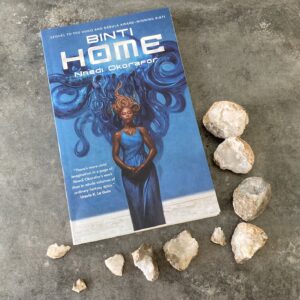
Binti Home, by Nnedi Okorafor

Binti is returning home, after a year of study at the university, with her alien friend, Okwu. She is not the same girl and it is not certain that there will be a place for her among the tribes of her desert homeland. She has been suffering PTSD after what happened on the journey out – waking dreams and hallucinations – and has been seeing a therapist.  As she approaches home, she considers how she hasn’t told her family about her hair not being hair anymore, that it was now a series of tentacles resulting from Meduse genetics being introduced to her genetics. She was still coming to terms with the sensation, and could hide the truth when speaking with her family through the astrolabe, but in person she wouldn’t be able to hide the fact that her locks moved on their own.

Surprises await her at home, and while some of her tribe are resistant to Binti’s changed outlook, acquired through inter-solar travel, the truth cannot be denied: Binti has seen the Night Masquerade. And so the story is told, blending culture and tradition with the innovation of space travel and marvellous invention. I loved the Africanfuturistic vison, with solar power ingrained into homes, covered by bioluminescent plants growing on the outside, homes that are more like self-sustaining creatures than homes. Among the tribes of her homeland, Binti learns about the mysterious and ancient edan she wears, and she discovers more about her origin, among the undying trees of the desert.

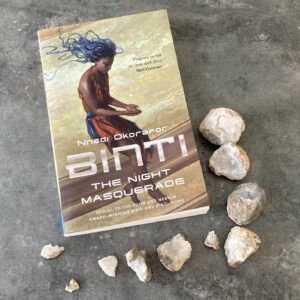
Binti, The Night Masquerade, by Nnedi Okofafor

In this concluding part to the trilogy, Binti returns, with a heartfelt tale that makes you just love her even more. A war is coming, and together with her new friend, Mwinyi, Binti attempts to stop it. Prepare for a feast for the imagination in what feels like an explosive finale. I adored the narrative, each word alive on the page, bursting with colour and invention. And I loved the deep-dive into the desert hinterland and the mysteries of the tribes. While Binti’s truths are layered in visions brought on by the alien zinariya, humanity and alien once again merge, taking us on a cascading journey of glorious technicolour. As Neil Gaiman says, ‘Prepare to fall in love with Binti.’

What are you reading?